
KennywoodLocation: West Mifflin, PA
|
At the end of the nineteenth century, a new wave of amusement parks swept the United States when trolley operators began opening parks along their routes to encourage ridership during the weekends. In 1898, Pittsburgh's Monongahela Street Railway Company opened one of these new “trolley parks” just across the Monongahela River from Pittsburgh, PA in a town called West Mifflin. The former picnic grove was located on Anthony Kenny's property, thus being named Kennywood Park.
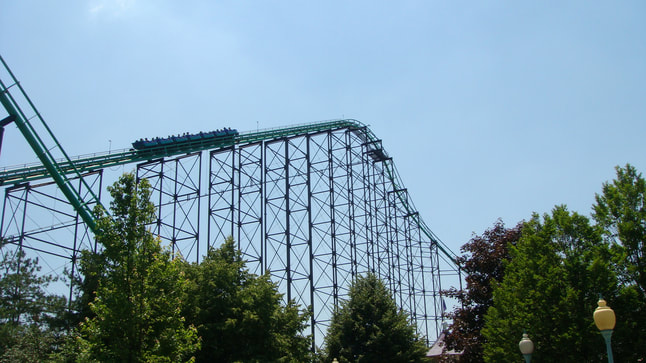
At the turn of the century, Kennywood's added the Old Mill, a combination of water ride and dark ride to compliment the park's small collection of attractions. 1902 brought a standard triple-figure-eight wooden coaster with a side-friction track built by Fred Ingersoll fittingly named Figure Eight. Over the next few years, Kennywood would remodel the coaster, and give it the new name Gee Whizz Dip the Dips. 1906 saw the opening of a second coaster and another standard for the early 1900s - Scenic Railway - a themed side-friction model. Kennywood would subsequently add two more coasters with John Miller's twin-tracked Racer (1910), followed by Speed-O-Plane (replacing Scenic Railway). No more coasters were added but a flat ride, the Whip, was added in 1918. John Miller’s Jack Rabbit was added to replace Gee Whizz Dip the Dips in 1921. Jack Rabbit had the distinction of using Miller's system of upstop wheels so that intense airtime elements could be included without any worries of the train derailing. Jack Rabbit's terrain-based layout saved on support costs. Miller was called in three years later to build a larger version called Pippin which also took advantage of another natural ravine. A new pool, new carousel and Turtle flat ride were added and the Kiddieland section opened in the old Racer’s place during the 1925-1927 seasons. In 1928, John Miller returned again with plans for the new Racer - a ride larger than before but still designed for all ages. The new layout was a moebius configuration with two sides racing over each half of the 4,500-foot layout. Brownie Coaster was added in 1928 then replaced in 1935 by Teddy Bear Coaster. Two years later, the Auto Race car ride was added. When the Great Depression and World War II era hit hard, the park managed to avoid the fate of a number of other parks through special events such as bringing in dance bands. Noah's Ark was completed in 1936. A second-hand ferris wheel was added. Olde Kennywood Railroad arrived in 1945, relocated from the 1939 World's Fair. In 1948, Dipper, which was later lengthened was added. Many new family rides and flat rides were installed during the 1950-60s. Notably the Wild Mouse and a second, more modern powered car ride - the Turnpike. An ambitious plan took place in the 1960s when Pippin was lengthened with the help of Andy Vettel. A former double-out and back layout was joined in the middle with a new circular half of the ride after a taller lift hill above the ravine, creating a very unique 2,887-foot ride renamed Thunderbolt. The next decade brought Kennywood's largest investment yet, a large log flume dubbed Log Jammer in 1975. That was the same year that disaster struck with a fire destroying four smaller rides. The park would recover quickly and add two flat rides, Gran Prix and Enterprise. 1980 was the year that a tubular steel coaster made its debut at Kennywood when Laser Loop blasted off. The standard Schwarzkopf shuttle coaster launched riders through a loop and up a 138-foot reversal tower spanning the side of the park. Kennywood then introduced another dark ride, the themed experience Gold Rusher. Other important rides added in the eighties were Raging Rapids replacing the Dipper and the Pirate, Wave Swinger, Musik Express, Flying Carpet, and Swing Around. In 1987 the amusement park became the first ever in the country to be declared a national historic landmark. 1991 would see a new addition that would catch the thrill ride world by surprise. The new world's fastest, longest-plunging steel coaster: Steel Phantom (partfs of which took the place of Laser Loop). Using the property's terrain again, Kennywood managed a 225-foot second drop through the Thunderbolt to reach 80-mph speeds and complete four inversions on the Arrow Dynamics-crafted track. After the debuts of two more flat rides, Wipeout and Bayern Kurve, Kennywood thought big again when adding the world's tallest Skycoaster attraction in 1994, at 180 feet. In 1995, Kennywood undertook their largest expansion. Lost Kennywood, themed after the Luna Parks of the 1920s. This is where the Whip, Wave Swinger, and Pittsburgh Plunge are located. Kennywood's first steel kiddie coaster, the Lil' Phantom, was added in 1996 and Noah's Ark underwent revamping. Kennywood made another bold statement in the amusement industry in 1997 by installing the tallest free-fall tower ride on the continent: Intamin’s 252-foot PittFall located in the Lost Kennywood expansion. After a century in business in 1998, Kennywood began construction on the sixth coaster and third dark ride in the park - Exterminator. In 2001, Steel Phantom underwent renovations by D.H. Morgan. The new and improved ride reopened as Phantom's Revenge. Aero 360 debuted the next year replacing the Wonder Wheel. In 2003, King Kahuna brought attention to a new area of the park – Volcano Valley. In 2004 the 103-year-old Old Mill was re-themed into a dark ride, Garfield's Nightmare. Phantom’s Revenge currently is tied as the 10th fastest coaster in the world. It’s a favorite among coaster aficionados. The dark rides have been a favorite of dark ride fans such as DAFE -Dark Ride and Funhouse Enthusiasts. Kennywood, now owned by Palace Entertainment, has defied the odds to thrive so that families have been able to enjoy the fun atmosphere for generations. |
Media Gallery
©1998-2016 COASTER-net.com, All Rights Reserved.
